Should You Do a Cloud Certification? The Four Reasons I Tell People Not to Collect Them, What the Exams Cost in 2026, and the One Case Where a Certificate Is Worth the Money

TL;DR
- Certifications are not bad; chasing them is. A badge proves you reached the passing mark on one exam on one day. It does not prove you have run the service in production, and the terms attached to every badge say so.
- The four reasons from the video: certification overload (AWS, Azure, GCP, Kubernetes, AI, security; you cannot watch every show on Netflix either); the asterisk effect (passing mark, not expertise); certificate-collector syndrome (badges as Pokémon cards on LinkedIn); and the 24 hours you have, which a day job already takes most of.
- What they cost in 2026: AWS Solutions Architect Associate 150 USD, 65 questions, 130 minutes; AWS Cloud Practitioner 100 USD, 65 questions, 90 minutes; Google Associate Cloud Engineer 125 USD, 2 hours, valid 3 years; Azure Administrator priced by country and must be renewed. Plus the weeks of evenings.
- Do one when the job needs it. If your work is Ansible automation on servers, an AI certification does nothing for Monday morning; the Ansible, bash and networking hours do. Pick the single exam that matches the work in front of you, or that a specific employer asks for in writing.
- What to do with the time instead: answer questions on Stack Overflow, fix issues on GitHub, write up what you ran, and build things you can show. Those are the recommendations from the video, and the examples of real-world experience it names are securing data, building secure pipelines and automating on-prem as well as cloud servers.
- Not your exact case? If you have decided to sit the Terraform exam, my Terraform Associate course is free; if you are starting from zero, read what to learn before cloud first.
Table of Content
- Why I made the video
- The four reasons, from the recording
- What the exams cost in 2026
- The one case where I would pay for an exam
- What to do with the hours instead
- What went wrong in the video
- Conclusion
1. Why I made the video
In August 2024 I recorded a 5 minutes video called The Cloud Certification Trap. It became the most watched thing on my channel, past 104,000 views, which tells me the question is on a lot of minds: should I spend my evenings on a certification? My answer in the video was no, with four reasons, and two years later I still give the same answer to people who ask me after a course or in the comments. This post is that answer written down, with the prices and exam formats checked against the vendors' pages on 2026-10-21, and with the part I think I undersold at the time.
Let me say first what the video also says first: certifications are not inherently bad. A certificate can make a resume stand out from a pile, and some employers filter on them. The argument is about where your limited hours go, and about what a certificate does and does not prove.
2. The four reasons, from the recording
These are the four points from the video, in my words from the transcript, so you can check I am not rewriting history:
 1Reason 1 - certification overload
 2  "there are cloud platforms such as AWS, Microsoft Azure, GCP and apart from that there are
 3   certifications like Kubernetes, AI, security and the list goes on ... it's just like watching
 4   every possible episode of every show on Netflix, which is unnecessary and impossible"
 5Reason 2 - the asterisk effect
 6  "a certificate means that you have obtained the passing mark to clear that particular exam.
 7   It doesn't mean that you are an expert on that subject"
 8Reason 3 - certificate collector syndrome
 9  "it feels like they are just collecting Pokémon cards and they have some kind of obligation
10   to collect them all ... employers are also looking for some real-world experience"
11Reason 4 - you only have 24 hours
12  "you have a very limited time to focus on certain things, then why not focus on the things
13   which bring the value"
Reason 1, certification overload. Three major clouds, each with a ladder of exams, plus Kubernetes, security, AI and networking specialities. Every one costs money and weeks. Nobody needs all of them, and the ladder is designed to make you feel you do. The example I used: if your day job is setting up servers and writing Ansible automation, an AI certification does nothing for that job. The Ansible Tower, bash scripting and networking hours do, because they are what you troubleshoot at 2 am.
Reason 2, the asterisk effect. Read the terms attached to a badge. It certifies that you passed an exam. It does not certify experience, and it does not make you a "super cloud expert" on the subject, however the LinkedIn post phrases it. I would rather have the real-time experience than the concept I will never use.
Reason 3, certificate-collector syndrome. There is nothing wrong with posting a badge. There is something wrong with the feeling that you must collect the full set. The badges make a resume stand out; the examples I gave in the video of what employers also look for are securing data, implementing secure pipelines and secure automation, and covering on-prem servers as well as cloud ones. Those are experiences, and a certificate is not evidence of any of them.
Reason 4, you only have 24 hours. A day job takes eight or nine of them. Whatever is left is the budget for everything else, and a certification path spends it on reading for a test. Spend it on the skills and experiences that make a difference in the job you have or the job you want.
3. What the exams cost in 2026
The video said "a certain amount of money and time". Here are the numbers, from the vendors' own pages on 2026-10-21:
| Exam | Fee | Format | Validity |
|---|---|---|---|
| AWS Certified Solutions Architect - Associate | 150 USD | 65 questions, 130 minutes | 3 years |
| AWS Certified Cloud Practitioner | 100 USD | 65 questions, 90 minutes | 3 years |
| Google Associate Cloud Engineer | 125 USD plus tax | 2 hours | 3 years, renewal exam available |
| Microsoft Azure Administrator Associate (AZ-104) | priced by country | proctored exam | expires unless renewed yearly |
The fee is the smaller cost. The larger one is the preparation, which is measured in weeks of evenings per exam on top of a day job, for an exam that itself runs 130 minutes. Multiply that by the "collect them all" instinct from reason 3 and you have a year of evenings on exams for three clouds you will never work on at the same time.
One more number worth knowing: AWS and Google credentials expire after 3 years, and Microsoft lists a renewal frequency of 12 months for the Azure Administrator. A certificate is a subscription, not a purchase.
4. The one case where I would pay for an exam
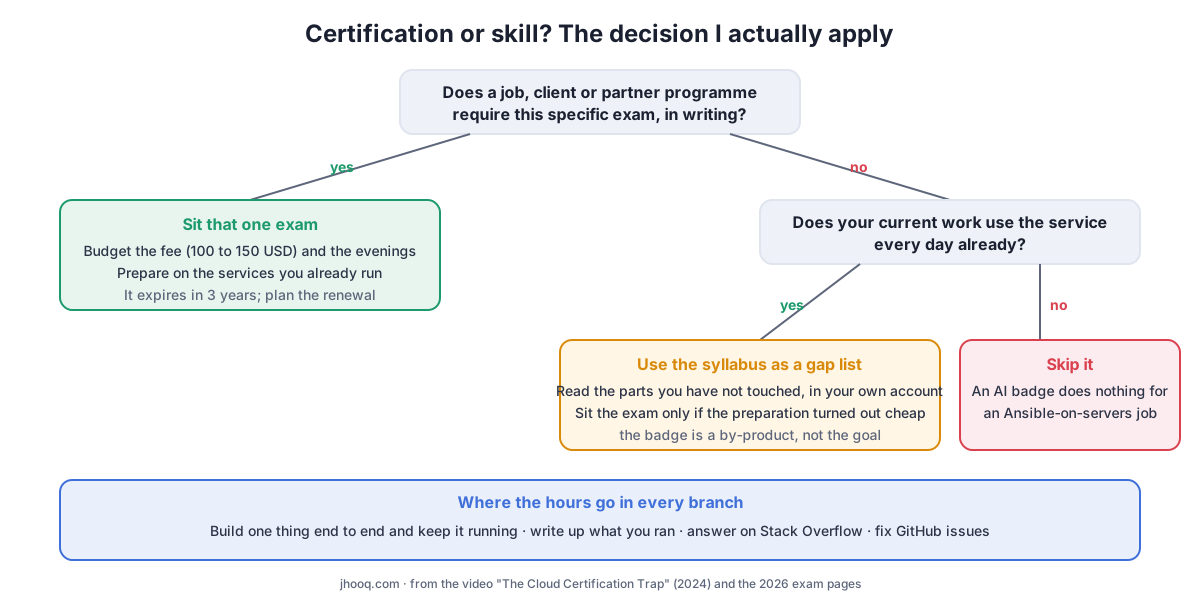
The video ends with "choose the certification which is really needed for your current job requirement", and that is still the whole rule. Concretely, I would sit an exam when one of these is true:
- A specific employer or client asks for it in writing. Some job posts filter on a badge, and some consulting engagements require certified staff. That is a business need you can price.
- Your current work already uses the service every day and the exam syllabus is a checklist of gaps in what you have touched. Then the preparation is cheap, because you are reading about things you have done, and the syllabus finds the corners you skipped.
- You are changing field and have nothing else to show yet. For someone moving from support or testing into cloud, the Cloud Practitioner at 100 USD is a reasonable first proof of intent, as long as it is the start of building things and not a substitute for it.
In every other case, the hours in the next section pay better.
5. What to do with the hours instead
My recommendation in the video was three things, and I would add a fourth today:
- Answer on Stack Overflow. You learn more from one problem you had to reproduce than from ten practice questions, and the answers are public proof of what you can do.
- Contribute to GitHub issues. Not features; issues. Reproduce a bug, add the missing detail, send a small fix. Maintainers remember the people who do this.
- Write up what you ran. A blog post with the real commands, the real error and the fix is a portfolio entry an interviewer can read. Every tutorial on this site is one of those write-ups.
- Build one thing end to end and keep it running. A VPC with a real workload, a pipeline that deploys it, a cost report you read every month. The free Terraform and Ansible material on this site is built for exactly that, and none of it is behind an exam fee.
If you want a syllabus for the fundamentals under all of this, the companion video to this one lists the six non-cloud skills to learn in parallel: what to master before learning cloud.
6. What went wrong in the video
1. I did not give a single number. "A certain amount of money and time" was vague, and the question people actually have is whether 150 USD and 8 weeks is worth it. Section 3 is the correction, and the honest answer is that the fee is never the problem; the evenings are.
2. The title lands harder than the argument. The video's last minute says "choose the certification which is really needed for your current job requirement", which is a rule, not a ban. The title says trap. For a career changer with nothing to show yet, the rule allows a cheap fundamentals exam as a first step, provided building something follows; section 4 spells that out because the title does not.
3. I said employers "are just not looking for certifications". The sentence continues "they are also looking for some real world experience", and that second half is the point. Some job posts do filter on a badge. The accurate version is that a certification can get a resume past a filter and experience gets the job; the mistake is spending all the hours on the filter.
4. I pointed at Stack Overflow and GitHub but not at writing. The video does say "write some blog", in passing. Writing up what you ran is the one of the three that also leaves a record an interviewer can read, so section 5 gives it equal weight.
7. Conclusion
To summarise:
- A certificate proves you passed an exam, with an asterisk; it does not prove experience.
- There are more exams than anyone needs, they cost 100 to 150 USD each plus weeks of evenings, and they expire after 3 years.
- Do one when a job, a client or your current work actually requires it; otherwise spend the hours on building, writing and helping.
- The people who hired me looked at what I had run, not at the badge row.
Did this save you a debugging session? Stay in the loop -
- Subscribe on YouTube - every post here has a screen-recorded companion video.
- Code on GitHub - the repositories, Terraform and scripts behind these posts.